Detours
Angie's LandmarksRoadside Wisdom
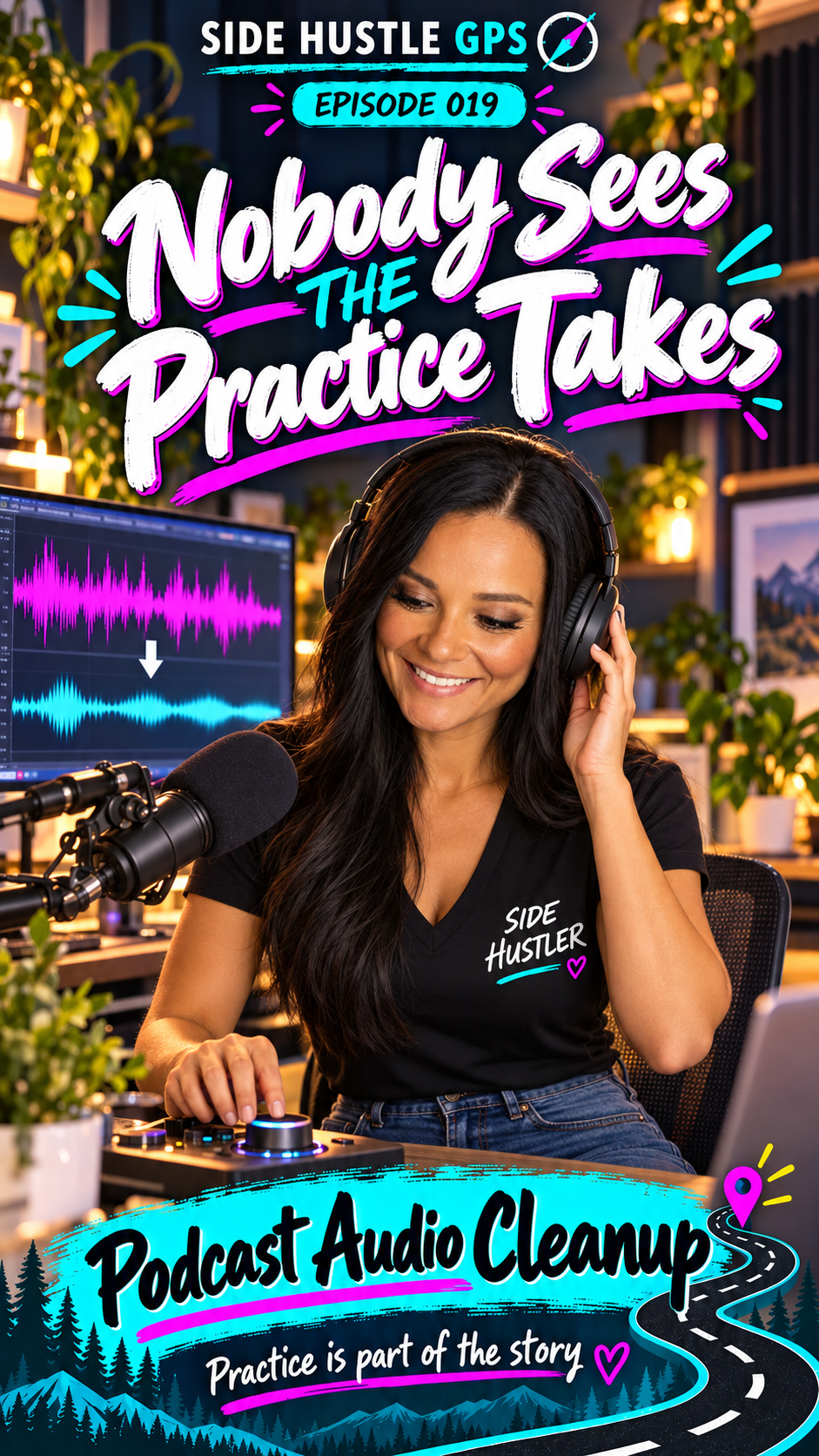
Nobody Sees the Practice Takes
Read transcript
Nobody hears the finished podcast and thinks, “I wonder how many ums she cut out.”
But let me tell you—somebody had to listen to them.
And for hundreds of hours, that somebody was me.
I’m Angie Norris, and this is Side Hustle GPS. Today, we’re stopping in Creator Coast to explore Podcast Audio Cleanup.
I’ve spent a lot of time working through recordings.
Thirty minutes. An hour. Two hours.
Listening for long pauses, repeated words, mistakes, and background noise.
Finding the places to cut, making the edit, then listening again to make sure it still sounded natural.
It was a lot of manual work.
And when you do it well, people often don’t notice the editing.
They just notice that the conversation is easy to follow.
That’s the value.
You’re helping the listener stay with the message instead of getting distracted by the recording.
Now, AI has changed how I approach that work.
I’ve used tools like Descript to help edit recordings without having to make every little adjustment by hand.
I call it “automagically.”
Because after spending so much time doing it manually, getting help with that first pass feels pretty magical.
But I still need to listen.
Sometimes a pause gives someone’s words meaning.
Sometimes an “um” is part of a natural conversation.
You don’t need to remove every breath until the person sounds like they’re racing through a script.
You’re trying to make them easier to hear while keeping them sounding like themselves.
And I have a pretty personal example of that.
This podcast.
Here’s a little behind-the-scenes spoiler: the voice you’re listening to is my AI Angie voice.
The stories are mine.
The experiences, the ideas, the opinions—all mine.
I start by talking through what I want to share.
I’m not worrying about every pause or whether I’ve said something in the perfect order.
I get the story out.
Then I use AI to help shape those thoughts into a script that keeps my voice and the essence of what I’m saying.
I review it, and I use a voice model trained on my own voice to create the narration.
It even reflects those little sounds that make me sound like me.
Braces, retainer, and all.
That’s a different process from cleaning up an existing recording, but it shows you how your audio skills can grow into related services.
Start with cleanup.
Then, as you learn, you might explore approved narration, intros and outros, or corrections a client asks you to make.
For any replacement speech, get the speaker’s permission and their approval of the final words.
You want the finished recording to represent what they actually mean to say.
I also love experimenting with audio storytelling.
One of my favorite AI party tricks is taking someone’s story and turning it into a conversational audio overview.
Watching them hear their own experience presented in a new way is so much fun.
But you don’t need to offer every possibility to get started.
A clear, focused service can be enough.
“I’ll clean up your podcast recording, balance the volume, and deliver a version that’s easier to listen to.”
That gives a potential client something concrete to understand.
And it gives you a skill to practice.
So here’s your first money move:
Record a short sample of your own voice.
Then make a cleaned-up version.
Reduce distracting background noise where you can. Trim an unnecessary pause or repeated sentence. Make sure the volume feels consistent.
Listen with headphones.
Did the edits introduce any strange sounds?
Did you cut a word too closely?
Does it still sound like a person talking?
Keep the original and the finished version so you can demonstrate the difference.
That before-and-after sample can help someone understand the service you offer.
So here’s your question today:
Who has something valuable to say, but a recording that makes it harder to hear?
Explore Podcast Audio Cleanup in Creator Coast at SideHustleGPS.com.
Nobody sees the practice takes.
But they can hear the difference when you’ve taken the time to get it right.
And practice is part of the story.
Practice is part of the story