Detours
Angie's LandmarksRoadside Wisdom
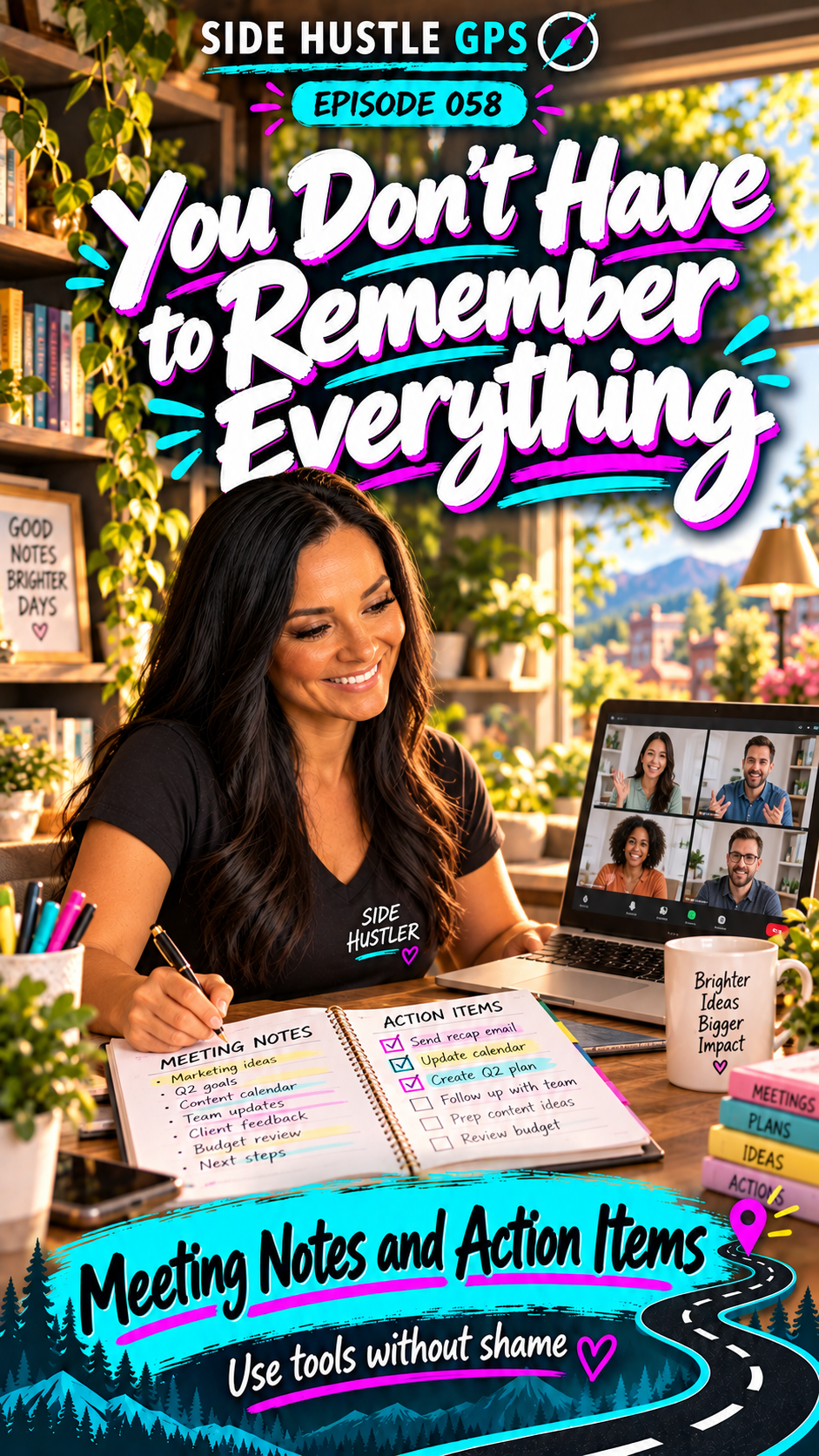
You Don’t Have to Remember Everything
Read transcript
Let me be completely transparent with you.
If I don’t write something down, there’s a good chance I won’t remember it.
I can have every intention of keeping a conversation at the top of my mind.
Then the work commitments, mom activities, to-dos, and new ideas start pouring in.
And whatever I was supposed to remember gets washed away.
I’m Angie Norris, and this is Side Hustle GPS.
Today, we’re stopping in Helping Hills to explore Meeting Notes and Action Items.
When I was in college in the ’90s, our only option for taking notes was pencil and paper—unfortunately.
Listen. Write it down. Study it later.
But between my memory and my handwriting, I felt like I had to work harder to keep up.
As technology became more available in my life, I kept thinking, “I wish I’d had that in college.”
Recording tools. Smartphones. Searchable information.
And now? AI note-taking, transcripts, screen recordings, and summaries.
It has been a total game changer for me.
Here’s one example.
Someone reached out because they wanted help understanding what they could do with AI in their business.
On our discovery call, I asked permission to record.
That recording gave me something I could return to afterward: their questions, their challenges, and the details of what they were trying to accomplish.
I used it with AI to help create an entire AI opportunity map and a presentation.
After I presented, they offered me the contract.
Could I have done that without the recording and notes?
Yes.
But having that information available helped me move so much faster.
I could spend more time developing useful recommendations and less time trying to remember exactly what they’d said.
That’s the value you can offer someone else.
A meeting might contain good ideas, important decisions, and commitments.
But once everyone leaves, who’s doing what?
What was agreed? What still needs an answer? What happens next?
You can help turn the conversation into something people can act on.
A clear summary. A list of decisions. Action items with the responsible person and the deadline, when those were actually agreed.
If something wasn’t decided, mark it as needing confirmation.
AI can help draft those materials from an approved recording or transcript. Your job is to check them against the conversation and make them useful.
You could offer a done-for-you service or teach someone how to set up their own process.
There are creative ways to build on it, too.
An approved conversation could become presentation notes, a visual plan, training material, or social content—when the client wants that information shared.
Start by solving the basic problem: helping people remember and follow through.
Use tools without shame.
Needing notes doesn’t make your ideas less valuable. It gives those ideas a place to live.
Your first money move?
Practice with a meeting you have permission to record or an existing transcript you’re allowed to use.
Create a short summary, a decision list, and clear next steps.
Then offer a small package for one meeting, with a defined length, delivery time, and client review.
Keep recordings private, use approved tools, and make accuracy part of what you deliver.
So, what conversation would become more useful if you could turn it into a clear plan afterward?
Explore Meeting Notes and Action Items in Helping Hills at SideHustleGPS.com.
You don’t have to remember everything.
Give your brain some support—and give the next step a place to land.
Use tools without shame