Detours
Angie's LandmarksRoadside Wisdom
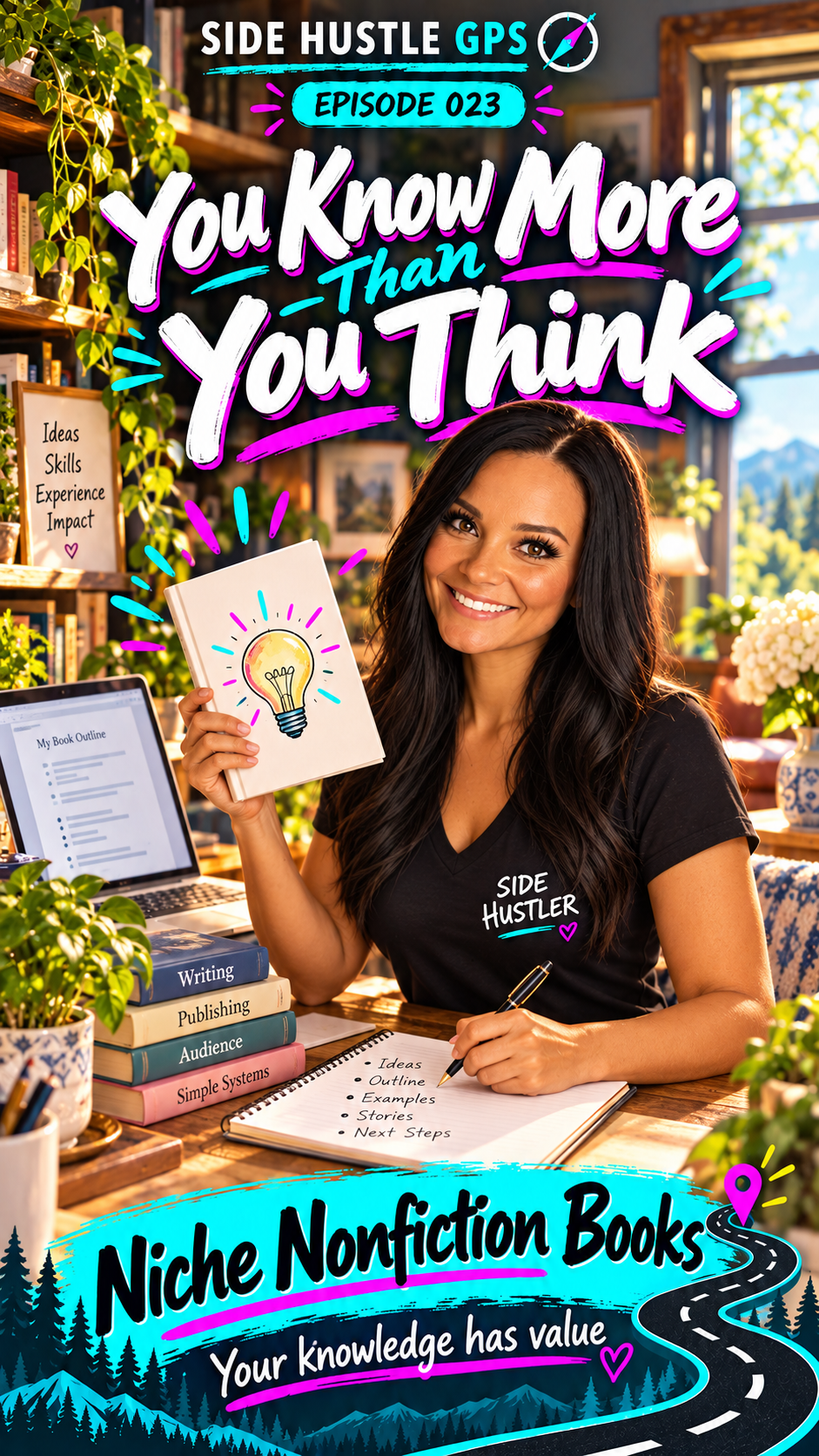
You Know More Than You Think
Read transcript
What do people always ask you about?
The thing you explain so often that you almost forget it’s something you had to learn?
There could be a book in that.
I’m Angie Norris, and this is Side Hustle GPS. Today, we’re stopping in Storybook Valley to explore Niche Nonfiction Books—and the value of what you already know.
I believe every person has something to share with the world.
Knowledge. Skills. Hobbies. Experience.
Things you’ve figured out through work, through practice, or simply through living your life.
Maybe you’ve learned how to organize something that overwhelms other people.
Maybe you know how to get started with a hobby.
Maybe you’ve spent years doing a job and can explain the parts a beginner struggles with.
You don’t have to know everything about everything.
You need something useful to share with a particular person.
Whenever I speak on a stage, teach a class, or create content, I think about reaching one person.
If something I share helps change one life, it was worth the effort.
That’s how I want you to think about your knowledge.
Who could it help?
And what could they do differently because you shared it?
A niche nonfiction book gives that knowledge a clear purpose.
A practical guide. A how-to book. A resource focused on one subject for one kind of reader.
You might know a lot about gardening.
But instead of trying to write everything there is to know about gardening, maybe your book helps a beginner grow herbs on a small apartment balcony.
That gives you a reader, a situation, and a useful outcome.
Now you can decide what belongs in the book.
What do they need to understand first?
What mistakes could you help them avoid?
What steps would make getting started easier?
And where would a story from your own experience help the lesson make sense?
That’s where AI can become a writing partner.
I use it to help organize ideas, develop an outline, and shape rough thoughts into a draft.
But I have to give it something meaningful to work with.
What I know. What I believe. What I’ve tried. What I’ve learned.
The examples and experiences that make the book mine.
Then I review what comes back.
Does it sound like me?
Is it accurate?
Does it actually help the reader?
AI can help you put your knowledge into words. You still need to stand behind those words.
And you don’t have to begin with a giant manuscript.
Start with one useful promise.
“This book will help this person do this thing.”
That sentence can keep you focused when you’re deciding what to include.
You can explore publishing a book of your own.
Or you could offer a service helping someone else organize their expertise into a book.
Think about someone you know who has years of wisdom but has never captured it.
You might interview them, help structure their ideas, and work with them to create a draft.
Their knowledge. Your help bringing it together.
Life stories and memoirs are another direction, but for this route, we’re focusing on knowledge a reader can put to use.
Something that answers a question or helps them take a step.
So here’s your first money move:
Write down three things people ask you about.
Choose one.
Then finish this sentence:
“I could help someone who is struggling with blank learn how to blank.”
Use that answer to sketch a simple outline.
What are the questions that reader would ask?
What would you want to tell them?
Draft one short section and share it with someone who fits that audience.
Ask what was useful and what they still need explained.
That gives you a starting point—and a chance to learn whether your idea connects.
So here’s your question today:
What feels ordinary to you because you’ve known it for years, but could be valuable to someone just beginning?
Explore Niche Nonfiction Books in Storybook Valley at SideHustleGPS.com.
You know more than you think.
And somewhere, there may be a person who needs the explanation only you would give.
Your knowledge has value